Updated June 17, 2026 12:35PM
Your Knees Can Handle More Running Than You Think, Especially With This Strength Routine
A physical therapist explains why this myth is wrong and how to build overall strength to bulletproof your knees against common causes of pain.

(Photo: Derek Call)
How many times have you heard from your grandma, a running partner, or even a medical professional that running is bad for your knees? My patients ask me all the time when they come in with knee pain if they should stop running. My answer is a resounding, “No!” Running is not bad for your knees. This bit of running folklore has been disproved with multiple research studies over the last several years.
Running is actually good for your knees; in a meta-analysis from 2017, runners had lower rates of knee and hip osteoarthritis (OA) than non-runners. A 2023 study found no difference in the prevalence of knee OA in runners with varying weekly running volumes compared with controls.
When you run, the loading that occurs improves the circulation of synovial fluid in your joints, helping to improve joint lubrication and nutrition. Every time you run, you are loading your bones and using your muscles and tendons, making them stronger.
But while running isn’t inherently bad for your knees, knee pain is the most common running issue. Around 50% of all running injuries are related to the knee.
So if running is not bad for your knees, then why does knee pain occur in runners? It doesn’t matter if it is IT band syndrome, patellar femoral pain syndrome, or even a degenerative meniscus—nearly all knee pain is due to poor control, poor training habits, and lack of strength. If you want to make sure your knees hold up for all the extra miles, here are a few things you can do to bulletproof your training.
ADVERTISEMENT
First, Assess Common Culprits of Pain
Often, knee pain is caused by training error. Look at your running history over the last three months and ask yourself the following questions:
- Did you have a spike in your training load?
- Did you add a different type of workout?
- Have you been under more life or training stress?
- Have you been eating enough calories to sustain your level of training?
- Are you sleeping enough?
- Are you doing any strength training?
When you slow down and ask yourself these questions, you may quickly figure out why your knees are hurting. If you find that you’ve trained too hard or have too much stress, dial things back, and you’ll be on your way to less injury.
If you aren’t sure what’s causing the issue and the thought of doing a squat sounds like agony, schedule an appointment with a running or sports PT. They will help you modify your running gait and focus on improving your strength, mobility, and training habits.

Strengthen Your Body to Handle the Load
Getting stronger requires consistency and progressive loading. Strength training is not just using TheraBands or doing bodyweight exercises. While both are helpful, it is also important to use weights.
No one exercise will fix your knees. To minimize the risk of knee pain, you will have to address hip strength, rotational control, quad strength, and core stability.
ADVERTISEMENT
Below is a 7-minute strength routine that hits all of these areas, and you can progressively add more weight as you get stronger.
Standing Clam

3 sets of 15 reps on each side
This exercise is great because it addresses single-leg strength, rotational stability, pelvic control, and foot position all at once. While it is using a band, it is still a great way to get what you need and warm up before any run.
- You will need a band and a wall, a tree, a fence, or a car to place a foot on for this exercise. Put the band around both of your legs just above the knees.
- Stand on one leg, slightly bent, while bending the knee on the opposite leg and planting the foot against the wall. Make sure you maintain a good arch by putting weight through all four corners of the foot. The knees should be level.
- Then pull your knees apart while maintaining the single-leg position. You will feel this in both hips. If you are losing your balance, hold on to something. Only pull apart as far as you can control your pelvis.
Squats With Heels Elevated

3 sets of 8-12 reps
- If you have any foot and ankle tightness that limits correct squatting form, elevating your heels eliminates that problem. This exercise is great for loading the quadriceps and for improving hip depth and increasing power. Squats are an exercise that you can start with no weight and progressively increase the load over time safely. You will need to have something to put under your heels—a weight plate, hand weights, a towel, or a wedge. Make sure your knees are pointing forward.
- Standing holding a kettlebell at the height of your chest, inhale, and as you exhale, squat down. Make sure you are going slowly; you will get more out of it if you don’t rush the movement.
- Lower down until you are approximately at 90 degrees, or your knees are in line with your hip.
Single-leg Romanian Deadlifts
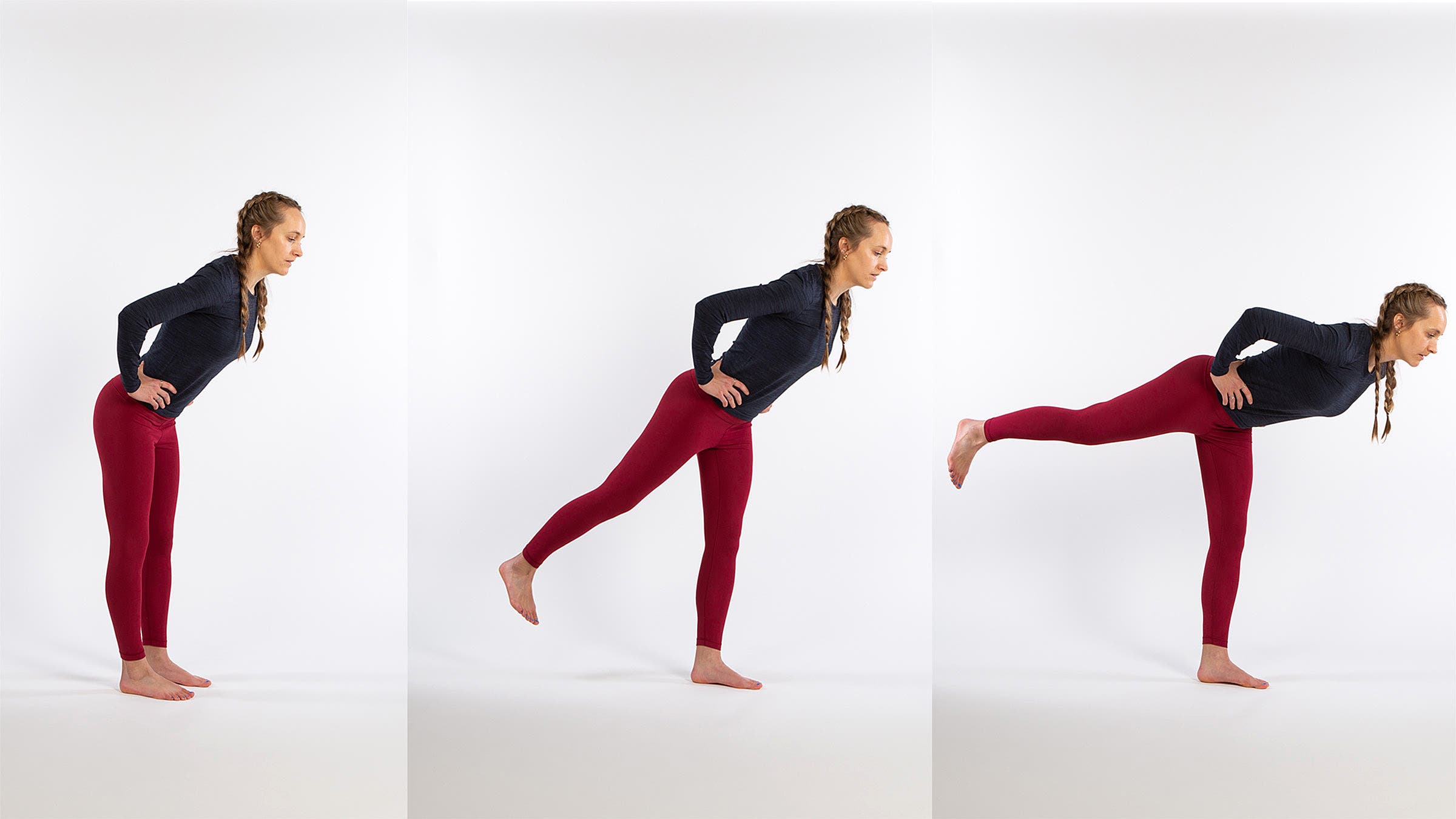
3 sets of 10 reps on each side
Running is a single-leg sport, so doing single-leg exercises is important. This move is particularly crucial because it challenges both leg and core strength. In addition, new research shows that RDLs are the new gold standard for unilateral hamstring strength in runners.
- Stand on one leg, focusing on pressing into the four corners of your foot and maintaining your arch with a slight knee bend.
- Take a kettlebell in the opposite hand and slowly tip over. You want to make sure that the leg in the air is reaching back and the toes are pointing toward the ground. Your hips should be level and pointing toward the floor.
- Maintain a slight bend in the standing leg, and reach the kettlebell toward your standing foot. You should feel this in the back of your leg, and the entire leg should be working. If you feel it in your back, you are not hinging enough from your hips.
ADVERTISEMENT
Side Plank with Leg Lift

3×5 repetitions on each side with 5 rotations each
This exercise is for core and hip stability and adds some rotational control into the mix.
- This is not a full side plank. You will bend your bottom knee and get into a modified side plank position with your elbow bent and directly under your shoulder, straighten your top leg, reaching through your heel, and lift.
- You want to make sure that you are pressing into your bottom knee, your hips are high, and you are not sticking your butt out.
- Lift your top arm straight up and then, while maintaining your trunk position, reach that arm under your body between your hip and elbow, rotating down, then bring it back up to the sky.
