Published February 26, 2026 06:00AM
You Just Crashed and Burned Mid-Race. Here's How to Turn It Around.
Ever had the wheels fall off mid-race, but weren’t sure how to respond? These three simple strategies from mental training coach Jeff Troesch will help you get back on track.
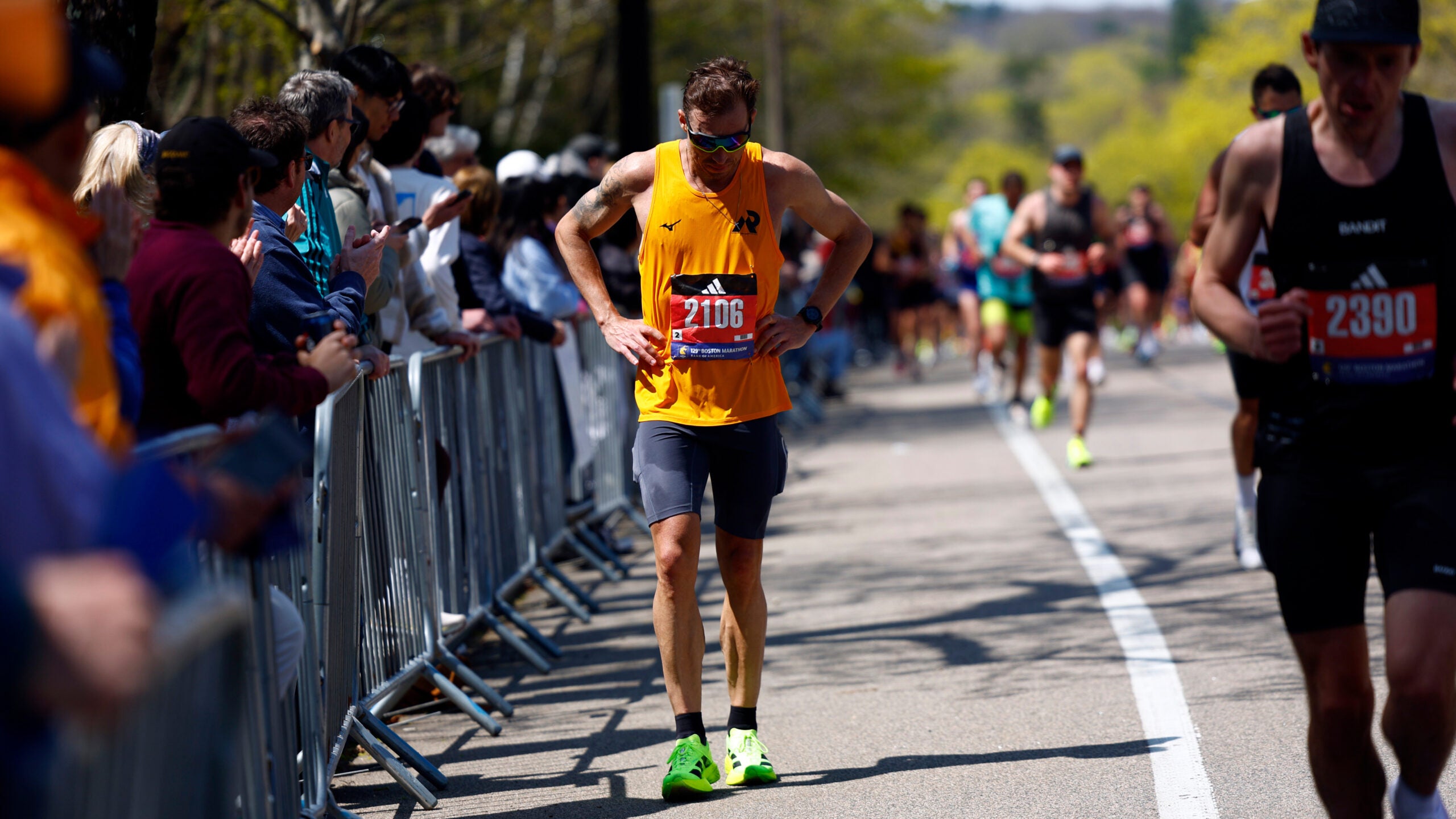
It can be a tiny disruption or a massive shift in the day that causes things to fall apart mid-race. Mental performance coach Jeff Troesch explains what to do. (Photo: Danielle Parhizkaran/The Boston Globe via Getty Images)
Your preparation was dialed, you had a solid race plan, you were fully committed to it … and then it all went sideways. The best athletes are capable of bringing mental discipline to a moment that initially feels like a complete disaster. Here’s your triage plan:
Recognize Your Response-Ability
Regardless of what has just happened in the race, you have the ability to respond to any circumstance in any way you choose. So first things first: Take ownership and responsibility and exercise your ability to respond. This can even happen before a race begins.
Here’s a real-life example: One of my coaching clients, a triathlete, showed up pre-race only to find out that the bike course had been significantly changed because of unexpected construction along the route. What was to be a relatively flat bike course was changed to one that would be more significantly hilly and require several additional climbs. There are many ways this athlete could have responded.
ADVERTISEMENT
When people don’t recognize their options, their ability to adapt and adjust to whatever circumstance just befell them weakens, and they sometimes end up playing the victim. They won’t feel like they’re in control of their next steps. It’s easy to be distracted by things that can’t be controlled—what just happened to you, why it happened, or who was to blame. You might even internalize a situation and your role in it—you are so frustrated about what you did that you don’t recognize that you have an opportunity to pivot and make an adjustment. Maybe the athlete in the example above could blame themselves for not doing more hill training—but what would that accomplish with no time to change training?
Or let’s say things are going very well in your race, but then you miss a water station on a hot day with more than half of your race to go. This kind of thing happens all the time, and someday it might happen to you. It’s common to get caught up in anger or frustration—succumbing to emotion rather than action. When you’re in the middle of a race and you feel mad or frustrated, that reaction distracts you from the all-important question: What do I do next? It’s a question that demands an intelligent and thoughtful response, not an emotional response.
Understanding your emotions is a part of life and sport. Emotions can often influence your response, but we want to minimize that influence. You want your response to be intentional so you can take full advantage of circumstances over which you have some influence or control.

The Race Doesn’t Care How You Feel
Many athletes give too much weight and power to their emotions in situations where action is required. Not feeling confident, feeling unmotivated, or feeling scared or nervous does not necessarily mean that the actions or the execution of a skill is going to be compromised. Certainly, sometimes these emotions can influence the quality of our execution, but there are any number of times where an athlete won’t exactly “feel right” and they still execute well enough to compete and potentially win. I hear every day about athletes who felt “off” and still won competitions big and small.
ADVERTISEMENT
My advice? Recognize if you’re stressing about being stressed or scared because you’re scared. Remind yourself about the multiple times where you haven’t felt perfect but still performed or trained quite adequately. Behave, act, and execute to the best of your ability, no matter how you feel emotionally, and do not let your feelings be an excuse or a reason for not giving 100% effort.
The night before an Ironman race, a client of mine reached out to share that she was having significant pre-race anxiety as her thoughts were flooding with all the things that “might go wrong.” I shared a reminder to this athlete that everyone in the race was likely feeling some anxiety and that the job at hand was to go and execute the race plan no matter how they were “feeling” in any given moment. The race turned out nicely as she broke the American record for an Ironman triathlon at that time. This race became important validation for this athlete that feeling insecure or being scared doesn’t necessarily mean she will have a bad race.
Sometimes you will not have the time or the technique or the awareness to fully manage your emotions into a “perfect” place. The race doesn’t know this, nor does your opponent. It’s up to you to act with boldness to the degree you can muster it and let your actions speak louder than your feelings.
“F*** It” Mode
Hesitation and tentativeness are a challenge for many athletes at all levels of sport, and especially when a race goes wrong.
ADVERTISEMENT
When facing moments of massive disappointment, indecision, anxiety, or self-doubt, I have had a lot of success with this simple strategy: Literally say, “F** it!” and go “all in” on the decision and the action. “F*** it!” doesn’t mean “I don’t care”—it means I accept the consequences and am going to stop worrying about how it’s going to turn out.
This “F*** it!” attitude is one I see my endurance athletes put to use often. Sometimes they just have to make a game-day decision: go with the pack or hang back, attack or defend, let the gap grow or chase it down. All of these are examples of often-faced scenarios when decisiveness in times of discomfort is crucial to give the athlete their best chance for success.
Even when the next technical or tactical adjustment feels scary or uncomfortable or impossible, “F*** it!” seems to work for a fair number of athletes. Athletes communicate that this strategy leads to feeling freed up and willing to take the risk that often aligns with effective execution.
And here’s a concession for those who might not prefer to say the F-word: “Screw it,” “Do it,” or a simple “I’m going all in on it” are all viable substitutes.
ADVERTISEMENT
I talk to athletes regularly about preparing their “fire extinguisher” for inevitable moments like this. When you commit to being one day better, there is something to be gained from every race, even a DNF.
Adapted with permission of 80/20 Publishing from One Day Better: Mental Performance Concepts to Transform Your Game and Life by Jeff Troesch. In this practical guide to mental skills, acclaimed mental performance coach Jeff Troesch shares concepts from over 35 years of coaching professional athletes in the world’s most popular and high-pressure sports, including the NFL, MLB, NBA, NHL, MLS, golf, tennis, triathlon, and NCAA collegiate sports programs.
