Published October 7, 2026 10:00AM
Why Record-Breaker Emma Grace Hurley Feared the Marathon
Top runner Emma Grace Hurley faces her fears by lining up for the Chicago Marathon on Sunday.

(Photo: Mike Lee)
For this article, Outside Run interviewed American elite runner Emma Grace Hurley in the lead-up to her Chicago Marathon debut.
When Emma Grace Hurley attended her first marathon finish line as a spectator, she was horrified. It was 2022 in New York City, on a record-warm day, and the struggle was real as runners streamed toward the famed race’s grandstand in Central Park. Despite being a star runner since she was a teen growing up in Roswell, Georgia, there was something about the marathoners staggering toward the finish that turned Hurley off the distance.
“Everyone looked miserable, like they were seriously injured,” Hurley, now 28, recalls. “I know it was really hot, but it actually scared me and made me fear the marathon for a while.”
On Oct. 11, Hurley will face that fear head-on when she makes her marathon debut at the Chicago Marathon, seven months after she was taken off course in the U.S. Half Marathon Championships.
After breaking Deena Kastor’s 21-year-old American record in the 8K at Chicago’s Shamrock Shuffle in March, she’ll return to the Windy City’s streets with a lot more confidence—and a lot less to be afraid of.
“I still have doubts about the unknown since it’s my first marathon, but my feelings about my own ability have changed recently,” she tells Outside Run. “I know I can run hard for a very long time. And the idea of slowing down and going longer feels comforting.”
ADVERTISEMENT
A Record-Setting Year
Up until this year, Hurley’s specialty was basically anything but the marathon on the roads. A 2020 graduate of Furman University, where she won an indoor conference title in the 3,000 meters, Hurley has steadily carved out a name for herself on the professional circuit. In 2024, she announced herself with a breakout win at the Indianapolis Monumental Half Marathon, where she ran a course-record 1:08:26 in her debut at the distance.
In late September, Hurley led the American women to a silver medal in the half marathon at the World Road Running Championships in Copenhagen, Denmark. She finished sixth with a personal best of 1:06:23.
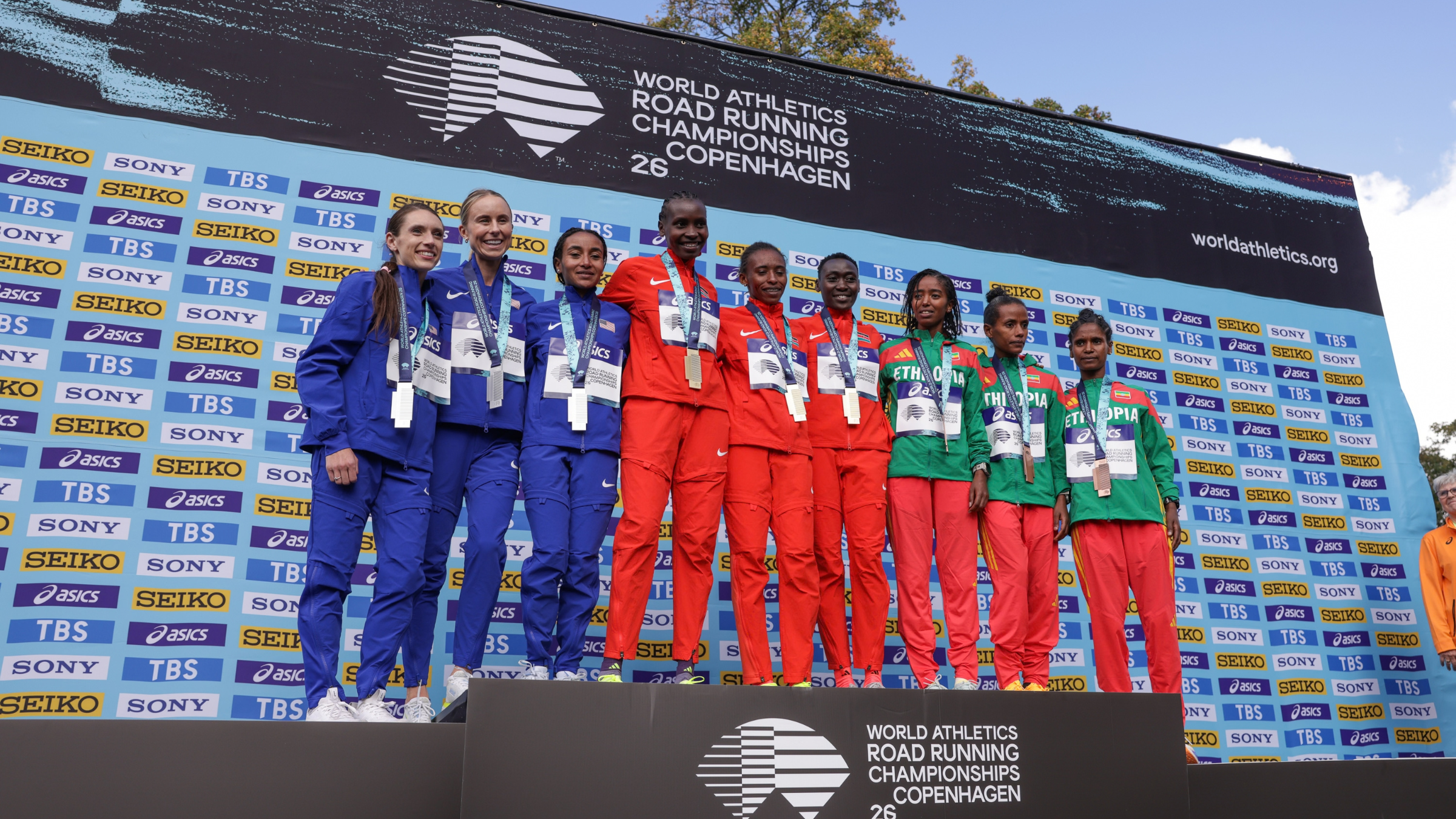
The breakthrough performance was a continuation of the success she’s had throughout 2026; this year alone, she’s picked up two national titles. In March, she won the USATF 10-Mile Championships at the Credit Union Cherry Blossom 10-Miler. In May, she followed that with a victory at the USATF 25K Championships in Grand Rapids, Michigan, running 1:22:51 to win by 47 seconds.
ADVERTISEMENT
In August, Hurley also finished fourth—and second among Americans, behind Jess McClain—at the Falmouth Road Race, running 35:36 in the deeply competitive 7-mile race.
From Zero to Indy
But the road to the top of the sport was a circuitous one. When her college career ended unceremoniously in the midst of the pandemic, Hurley quit the sport cold turkey, got a job in IT, and barely ran for 16 months. The motivation wasn’t there, she tells Outside Run, and she never saw herself as a professional runner, anyway.
“I wasn’t an All-American in college,” she says. “I never thought about being a professional runner. Early in my career, I feel like I got really fit quite a few times, and then something would pop up, like an injury, and I couldn’t run as fast as I wanted to. I always had a little bit more to give that I could never just quite get there. It just never was the right scenario.”
ADVERTISEMENT
It took new coaches, a new city and, now, a new routine to get that scenario right. She started running again in earnest after taking a high school coaching job at Marist School in Atlanta, where she began running with the girls she coached and reignited her inner fire for the sport. She eventually joined Atlanta Track Club Elite, where she trained under Andrew and Amy Begley and saw improvement almost immediately.
When the Begleys moved to Indianapolis for Amy’s role as the associate director of Long Distance Running Programs at USATF, Hurley followed, even if it meant uprooting the life she had built in Georgia. She initially kept her job in technical sales but eventually reduced her hours to the point where she decided to step away from the corporate world altogether.
And now? All roads lead to the marathon—and, hopefully, Los Angeles in 2028.
ADVERTISEMENT
New Digs
Despite “not knowing a soul” in Indianapolis, the adjustment to her new home was smooth. The city—and its running community—welcomed Hurley with open arms. She found regular running routes along the Monon Trail and is often seen grinding out her long runs with Andrew Begley biking alongside her. She also has an informal training group with local runners, including Caleb Kerr, who will pace her in Chicago.
“My friend group is a bunch of runners, and they may all wind up making the Olympic Trials, so it’s easy for me to find people to run with, but I also do a lot alone, with Andrew biking,” she says. “Being solo helps me stay in tune with my body.”
Hurley’s typical week features about 90 miles of running, although she has maxed out at 110. Prior to the marathon build, she stuck closer to the 75- to 80-mile range, but she and Begley have worked to gradually increase her volume.
ADVERTISEMENT
“We do some difficult workouts, and my miles add up,” she says. “So it’s not necessarily that my easy runs are getting longer, it’s more in the harder stuff.”
Outside of training, Hurley keeps her life tame: walking her dog, Ava, taking naps, hitting Taco Tuesdays at the local cantina, and enjoying quiet evenings at home.
“My life is pretty boring,” she says, laughing. “I really don’t do much else.”
Typical Day in the Life of Emma Grace Hurley
6–7 a.m.: Wake up and eat breakfast
8 a.m.: First run of the day
10–11 a.m.: Walk the dog and shower
12–2 p.m.: Nap time
3 p.m.: Second run of the day
5 p.m.: Chores, grocery store and walk the dog
7 p.m.: Make dinner, then sit on the couch and watch TV or talk on the phone
8–9 p.m.: Wind down and go to sleep
ADVERTISEMENT
Boring may be just the right formula for Hurley, who not only exceeded her “insane” goal of finishing within the top 10 at the World Champs, but also lopped more than a minute off her half-marathon PR in Copenhagen and leapt to number three on the all-time U.S. performer list. She hopes to continue that trajectory toward the 2028 U.S. Olympic Marathon Trials in St. Louis on March 25, 2028.
“When it comes to the Olympics, the marathon is the team I want to make,” she says.
But first: Chicago.
With it being her debut, Hurley is taking a measured approach and keeping her expectations tempered.
“I don’t want the first one to be phenomenal and then be like, ‘Crap, how do I replicate that?’” she says. “I want to take a big swing. I want to run really fast and leave some room for growth.”
In a way, she’s already beaten her biggest opponent: her own self-doubt.
“The marathon really did scare me,” Hurley says. “And now I’m excited about it.”