Published April 15, 2026 05:00AM
Jess McClain's Recipe for Success: Be Busy, Have a Blast
She works 40 hours a week, views races as runcations, and, not coincidentally, is a favorite to defend her title of top American at the Boston Marathon.

(Photo: Maddie Meyer/Getty Images)
Browse Jess McClain’s Instagram stories on any given day, and you’ll likely see the following: a photo of her dog, Clyde; a litter of puppies (a perk of her job as the executive director of a nonprofit rescue organization); a curated shot of the Arizona desert landscape in her backyard; or an exquisitely plated meal on a date night with her husband. It’s a glimpse of a life that looks lovely, yes—but also, well, quite normal.
Except McClain isn’t normal, at least by running’s standards. One of the featured names in the elite women’s field at next week’s 2026 Boston Marathon, she is among the favorites to once again be the top American to cross the line on Boylston Street, a title she claimed last year in a PR of 2:22:43. And while running may be a large part of her story, it does not define her. At 34, McClain has learned to purposefully build a life around more than the sport, one where elite training exists alongside work, relationships, and plenty of fun.
“There was a point earlier in my career where it was all about making the podiums and teams at all costs,” she said of her early years racing professionally—then as Jess Tonn—for Brooks between 2015 and 2019. “But I realized that was not the best approach. At the end of the day, all I really need to do to run well is get consistent training in and just have a lot of fun doing it.”
The Beauty of Balance
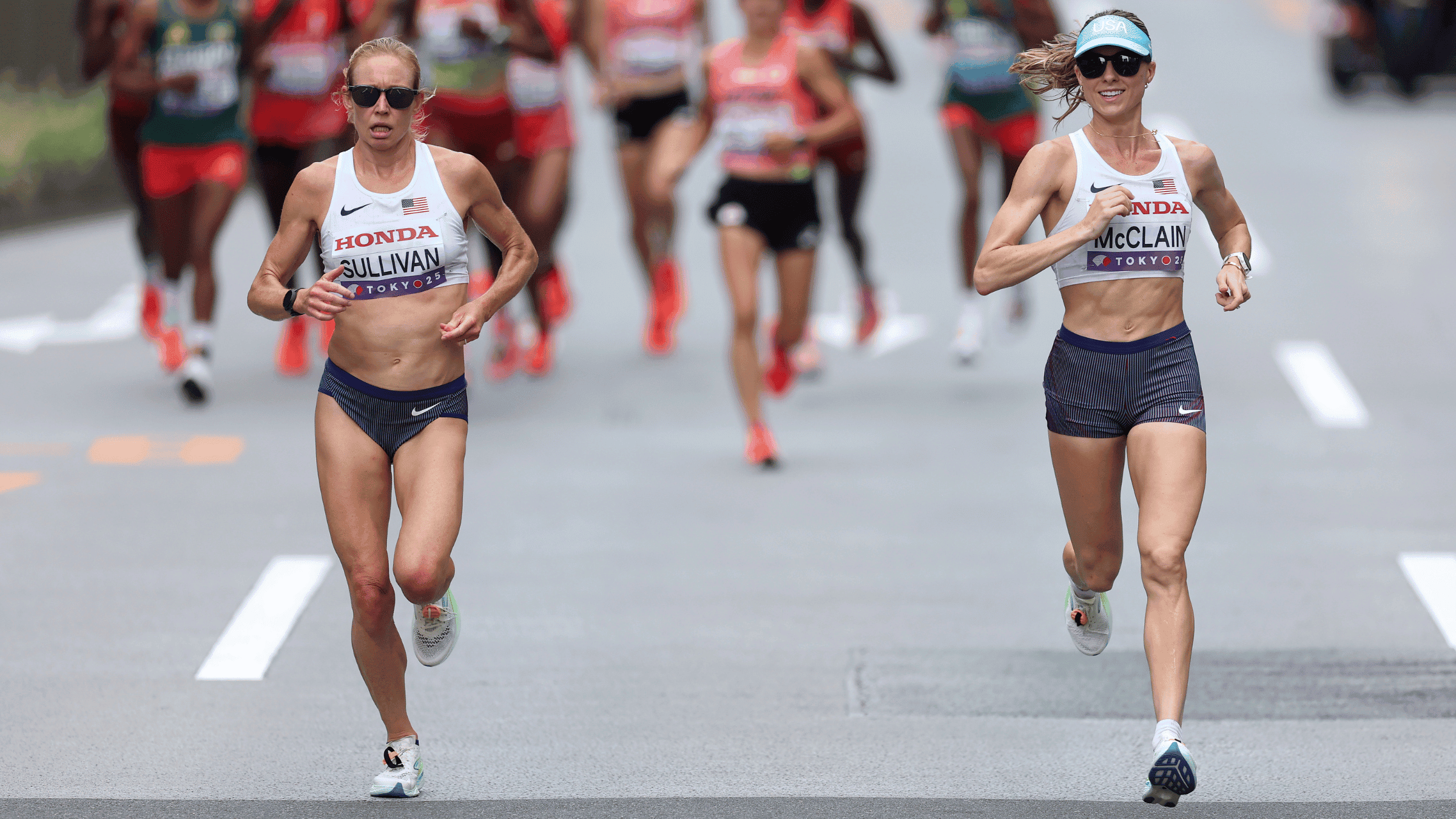
That balance hasn’t just reshaped her mindset. It has reshaped her results. Since returning to the sport in earnest in 2024, McClain has emerged as one of the country’s most promising distance runners, earning spots on two national teams, finishing eighth in the marathon at the 2025 World Athletics Championships in Tokyo, and narrowly missing an Olympic berth in 2024. Coached by ultrarunner and Some Work All Play podcast co-host David Roche, she trains with a small group of local runners primarily in Phoenix, Arizona, where she lives with her husband, Connor, and works roughly 40 hours a week across two nonprofits and a marketing role.
McClain acknowledges the setup is unconventional for an athlete of her caliber—but for her, it’s essential.
ADVERTISEMENT
“I’ve lived the life of having running be my full-time job day in and day out,” she said. “And personally, I just can’t operate in the sport in a healthy way with that approach. I just need something else to focus on.”
A typical day for McClain starts with an early-morning run, timed to avoid Phoenix’s mid-day heat. From there, she transitions into a full workday, splitting her time as the executive director of two Phoenix-based nonprofits—one focused on dog rescue, the other on foster youth and at-risk youth advocacy—alongside freelance marketing work. Her responsibilities range from event planning and fundraising to business development and sponsor relations. After work, she’ll spend time with Connor or meet up with friends for a girls’ night out.
“I definitely indulge from time to time. It’s just really good to have balance,” she said. “So when everything’s not great with running, I can look at all of the other things I’ve got going on and know it’s all going to be okay.”
ADVERTISEMENT
Race? For Jess McClain, It’s a Runcation
That grounding was especially clear after the 2026 U.S. Half Marathon Championships in Atlanta in March, where, in a now-viral moment, McClain—running with a significant lead—was directed off course by race officials near the 11-mile mark. The mistake cost her the national title and the finish she had been envisioning, turning what should have been a defining moment into a confusing and deeply frustrating one. (After some deliberation, she was ultimately awarded $20,000 in first-place prize money and given a berth to the World Championships in Copenhagen this September.)
“The hour and a half after the race, it was a lot of just letting myself feel the WTF-ness of it,” she said. “In the race, I just felt so confident. I was visualizing breaking the tape. So, yeah, I was angry. But then I left for home and had to go to work the next day, so I just got back to my routine and back to work.”
That ability to reset, she says, comes from having “other buckets” in her life to lean on—work, relationships, and perspective beyond sport. Connor, in particular, plays a key role in keeping things light.
ADVERTISEMENT
“He just makes me laugh all the time,” she said. “The first time he came with me to a major race was the 2024 Olympic Trials in Orlando. I was unsponsored, so I was going to all the different shoe company activations, hanging at the Brooks House, and meeting old friends. And at one point, Connor looked at me and said, ‘I think we’re the ones having the most fun here.’”
That moment marked a shift. What once felt rigid and isolating—“I used to just sit in my hotel room in my Normatec boots and think any time I spent out of the hotel room was going to detract from my race”—has become something far more open and shared. Now, McClain and her family approach race weekends as what they jokingly call “runcations,” blending competition with travel, connection, and joy.
“The minute the Copenhagen news came, my mother-in-law was like, ‘We’re in for a runcation,’” she said. “And Connor and I are like, how cool is it that we get to spend our mid-30s traveling and racing? We get to do this.”
ADVERTISEMENT
That perspective doesn’t make her any less competitive—if anything, it has sharpened her edge. In Boston, she’ll look to build on last year’s breakthrough and lower her PR. Longer term, she has her sights set on a world marathon podium and a spot on the U.S. team at the 2028 Olympic Trials. But she knows now that success isn’t defined solely by outcomes.
“Everything I used to fear, like frustration and disappointment…that’s happened, and I’m still here, grinding,” she said. “As silly as it sounds, my personal mission with running is just to keep it fun—to control what I can control and enjoy getting to the starting line. And I’m having a total blast.”
