Published May 12, 2026 07:09AM
Hear Thunder? Don’t Try to Outrun the Storm — Do This Instead
"Running falls just behind soccer and golf as one of the most hazardous outdoor activities during storms,” a meteorologist warns.

(Photo: Getty Images)
On April 9, 2026, a Colorado woman laced up her pink and white Saucony shoes and headed out for a run in the town of Superior. While running down a popular path, she was caught in an early-season thunderstorm and struck by lightning, leaving her without a pulse.
Fortunately, bystanders found the runner, whose name has not been released to the public, lying beneath a tree that had also been struck by lightning, and immediately began giving her lifesaving CPR. According to the Boulder County Sheriff’s Office, the runner is breathing independently and has regained a regular heart rate, but is still in critical condition.
She wasn’t struck by lightning while on a mountain adventure in the backcountry or a trail run in the forest. She was simply out for a run in a park, on a path neighborhood residents commonly use to walk and bike to the elementary school. Meaning, it could happen to any of us.
The Science of Lightning and Thunderstorms
As peak thunderstorm season approaches, you probably know to check the weather forecast before you head out the door for a run. During warmer months, however, pop-up thunderstorms can often form sporadically without much prior notice.
On a recent phone call with Outside Run, John Burchfield, a broadcast meteorologist in Toledo, Ohio, and marathon runner training to qualify for the 2028 U.S. Olympic Marathon Trials, explained that atmospheric characteristics make thunderstorms more common during the summer months. Rising warm air fuels thunderstorm development, while a strong cold front or other trigger acts as the impetus that sets off storm formation.
As thunderstorms form, rising air causes particles to collide and develop electrical charges thousands of feet up in the sky. Tiny ice crystals become positively charged as they bump into softer hail pellets, which develop a negative charge. The positively charged ice crystals rise upward, while the negatively charged pellets tend to collect at the base of the storm cloud. At the ground level, this causes a pool of positively charged particles to gather beneath the cloud, rising up through tall objects.
ADVERTISEMENT
Lightning is the electrical discharge between the negative cloud base and the positive ground surface. The tremendous heat produced by a lightning bolt can reach 50,000 degrees, causing a rapid expansion and contraction of the surrounding air, creating the sound of thunder that you hear after a lightning strike (not before).
“You’ve probably heard the saying ‘when thunder roars, go indoors,’ meaning that the sound of thunder is your cue to seek shelter during a storm. The only problem is that by the time you hear the thunder, danger may already be imminent,” Burchfield says, adding that we often hear thunder before we see the lightning because light travels faster than sound. “Thunder does not mean you can log a few more miles; this sound is a sign that you’re at risk if you don’t seek shelter immediately.”
And no, the rubber soles of your running shoes don’t keep you any safer. That’s a common but dangerous myth based on the fact that being in a vehicle is safer than being outside during a thunderstorm. “It’s not the rubber that makes a car safe. It’s the metal frame, which conducts the electrical current from a lightning bolt, causing it to travel around the car’s periphery and into the ground,” Burchfield explains.
Running the Risk of Being Struck
Seventy-three percent of lightning deaths occur in June, July, and August, which Burchfield attributes to atmospheric characteristics combined with the popularity of outdoor recreation during those months.
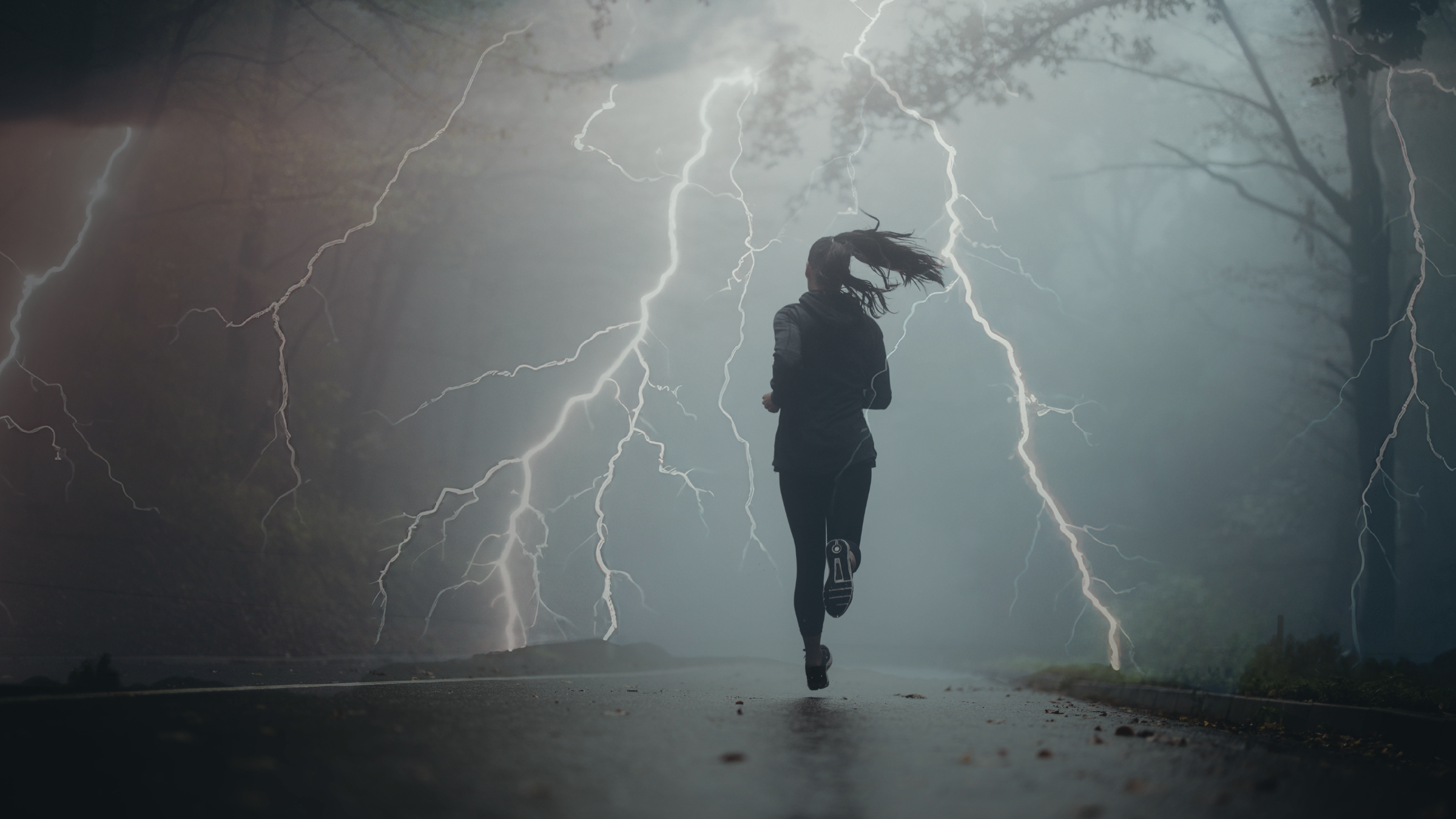
“During a thunderstorm, the most dangerous outdoor sporting activities are those that involve water or an exposed, open landscape. Running falls just behind soccer and golf as one of the most hazardous outdoor activities during storms,” Burchfield says.
ADVERTISEMENT
The electrical discharge of lightning favors taller objects that are closer to the clouds, such as trees, telephone poles, lamp posts, and buildings. If you’re in the middle of an open landscape, that object could be you.
“That’s why running in open areas is a big no-no during thunderstorms,” Burchfield says. “So is trail running, which presents its own risks because trees are so susceptible to lightning strikes.”
Off for a run in the mountains? Since rising air associated with the high-elevation geography can cause thunderstorms, you might be tempting fate. Looking forward to a scenic run in a coastal area? Be wary of pop-up thunderstorms that can occur without warning along marine boundaries, especially in the afternoon.
The Do’s and Don’ts For Staying Safe During Thunderstorm Season
According to the National Weather Service, between 300 and 400 people in the U.S. are struck by lightning annually. In about 10% of cases, lightning strikes are fatal. As for the other 90%, the physical effects of getting struck can last a lifetime. An estimated 70% to 74% of survivors suffer from permanent impairments, including cardiovascular and nerve damage. Other possible injuries include neurological damage—such as permanent brain injury and temporary paralysis—as well as ruptured eardrums, deep tissue damage, and severe burns to the skin.
ADVERTISEMENT
Check the weather, and adjust plans accordingly.
To avoid getting caught in a potentially dangerous situation, be cognizant of the weather forecast in your immediate area and the surrounding area. Even if there is a 30% chance of thunderstorms, be prepared to seek shelter at a moment’s notice.
Consider running a one-mile loop or shorter, starting and ending at your vehicle, workplace, or home. An adequate alternative is to plan a route that passes public rest stops, gas stations, or other secure buildings.
ADVERTISEMENT
“Being stranded miles away from shelter during a thunderstorm because you ran an out-and-back route is a worst-case scenario. Do have a shelter location in mind before heading out for your run,” Burchfield suggests. If you get caught in a thunderstorm while out running, get indoors or in your nearby vehicle immediately.
If you get caught in the mountains, move to lower ground.
Should this be impossible because you’re running on remote hilly or mountainous terrain,move to lower ground right away. You’ll also want to get as far away from any bodies of water.
Avoid trees.
“Do NOT hide under a tree. This is the second leading cause of death during thunderstorms. Tall objects that are isolated are effectively nature’s lightning rods,” Burchfield says. If you happen to be running in a forest full of trees (a far from ideal situation), hide under the shortest tree you can find.
When lightning is imminent, hit the ground.
If you cannot take any of these precautions, get as low to the ground as possible and curl up in a ball, with your feet together, head tucked, and ears covered. The goal is to minimize the amount of surface area between the ground and your body, so do NOT ever lie flat on the ground.
ADVERTISEMENT
Don’t think you’re safe on a treadmill.
“While less risky than running outside, the treadmill does come with safety risks and is generally not advised during a thunderstorm,” Burchfield says. “Appliances that are plugged in can transfer the electrical surge from a lightning strike, shocking anyone in physical contact.”.
If that’s not enough to keep you off the treadmill during a storm, consider that the massive spike in voltage can damage or ruin your treadmill. “Another risk that many do not think of is a sudden power loss that can abruptly bring a steady pace to a halt, causing you to trip and fall on the treadmill, potentially resulting in injury.”
Living to Run Another Day
The incident in Colorado is a startling reminder of just how dangerous lightning and thunderstorms can be if you don’t take the proper precautions, no matter where you run. The runner struck by lightning was discovered by bystanders who not only knew CPR but also understood that the human body does not store an electrical charge.
ADVERTISEMENT
As such, helping a lightning strike victim does not pose any danger to you, so if you encounter someone who is struck by lightning, assist them by calling 911, moving yourself and the victim to a safe location, checking for breathing and a pulse, and administering CPR immediately. You just might be the reason another person lives to run another day.
