Published October 30, 2026 07:20AM
The Fastest Shoes of the New York City Marathon: A Decade-by-Decade Retrospective
This is more than just gear nerdery. The shoes behind New York’s fastest times reveal decades of innovation, drama, and the occasional wardrobe malfunction.

At right, Bill Rodgers competes in the 1976 New York City Marathon. At left, Grete Waitz at the start of the 1979 New York Marathon. (Photo: NYRR and Getty Images)
How We Reported This Story: Oscar Bem identified the shoes athletes wore to run the fastest times at the New York City Marathon from the 1970s to 2025. He spoke with representatives of Nike’s history management team, Will Smiarowski at Reebok, Alberto Locatelli of the Adidas Archive, as well as Filippo Pavesi, former research and development manager at Fila. He also spoke to athletes Bill Rodgers, Allison Roe, and Ingrid Kristiansen to ask about the shoes they wore decades ago.
Over the past five decades, the New York City Marathon has undergone an incredible transformation, growing from a small gathering in Central Park to an event that brings the entire city together. Parallel to this has been the transformation of running shoes.
ADVERTISEMENT
Supershoes have given all runners, from the elite to the everyday, access to advanced foam and carbon-fiber plate technology and its benefits. Go to any run club, and you’ll hear buzzwords that would make a layman believe we’re all shoe engineers: running economy, rocker angle, PEBA, A-TPU. Discussing the construction of a shoe and what it’s made of is now as common as naming its brand.
To me, however, the early days of footwear technology are just as interesting as the next iterations of supershoes. I am a marathon shoe history nerd, and I’ve made it my mission to find out what superstars of the past were wearing on their feet when they crossed the line. To confirm which athletes were wearing which shoes, I spoke with past champions as well as brand reps and historians at Adidas, Asics, Nike, and Reebok.
It might seem arbitrary, but looking into what shoes broke the tape is like a portal into running’s past. There’s the evolution of design, of course, but also long-forgotten controversies and headline-making mishaps. See below for shoes that set records, infamous short courses, and shoelace fails.
ADVERTISEMENT
Remember the Tiger — and Other 70s Treasures
Men’s Fastest Times of the Decade
| Time | Year | Athlete | Shoes |
| 2:10:09 | 1976 | Bill Rodgers | Onitsuka Tiger Ohbori |
| 2:11:28 | 1977 | Bill Rodgers | Onitsuka Tiger Ohbori |
| 2:11:42 | 1979 | Bill Rodgers | Asics X-BR |
Women’s Fastest Times of the Decade
| Time | Year | Athlete | Shoes |
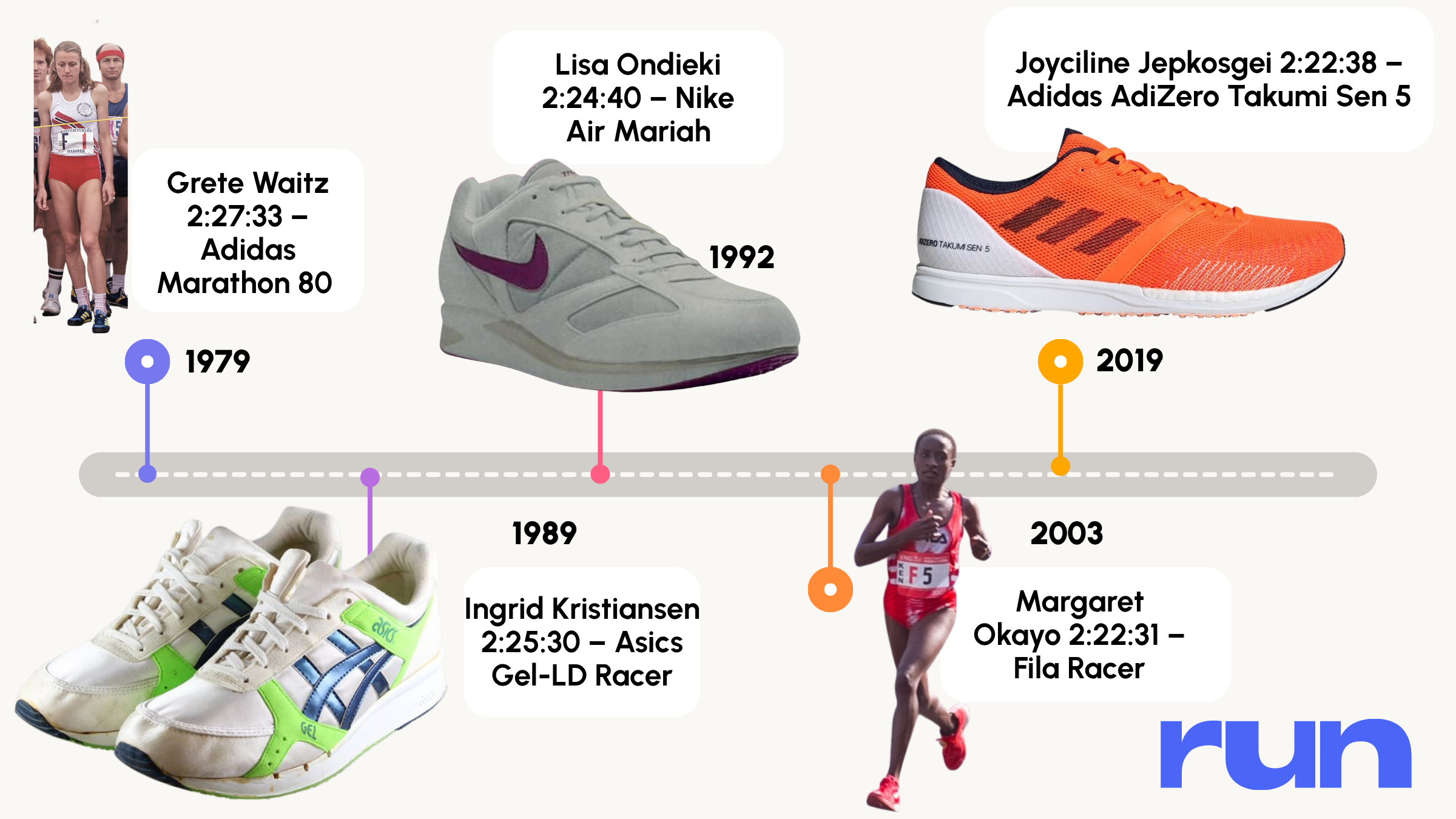
| 2:27:33 | 1979 | Grete Waitz | Adidas Marathon 80 |
| 2:32:29 | 1978 | Grete Waitz | Adidas Marathon 80 |
| 2:38:33 | 1979 | Gillian Adams | Nike Elite |
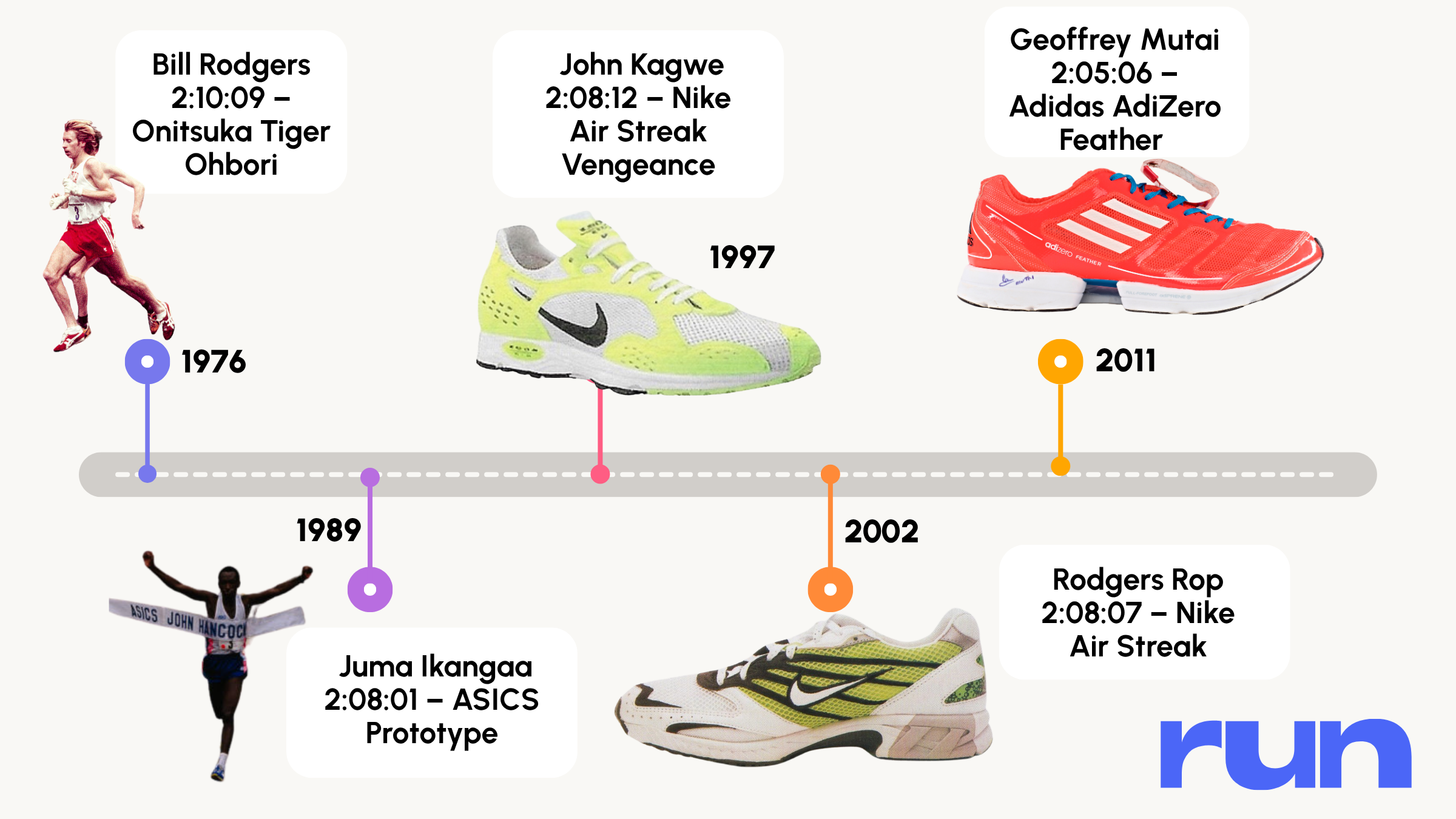
The seventies saw seismic changes for the New York City Marathon, starters growing from 127 in 1970 to 11,533 by 1979, with the course altered from loops of Central Park to traversing all five boroughs from 1976 onwards. It was an equally significant time for running shoes, with the legendary Bill Rodgers using the Onitsuka Tiger Ohbori to set the fastest two times of the decade.
Introduced in 1974, the model was the first marathon racing shoe to use Ethylene-Vinyl Acetate or EVA foam, which became the default running shoe midsole material for decades. The 1975 Brooks Vantage is often considered the first running shoe to use EVA, but not so fast, says the official Asics history books. Regardless of who actually won the EVA war, Rodgers dubbed the Ohbori the supershoe of the seventies. He used an updated version for his 1979 victory, running the third-fastest time at New York that decade.
Women’s distance running also saw huge transformation, with Grete Waitz setting two world records in 1978 and 1979. She wore the Adidas Marathon 80. Every part of the 179-gram shoe was designed to help runners: the heel spoiler was meant to help with impact, specially configured studs aided traction, and polyurethane in the midsole helped with cushioning.
ADVERTISEMENT
Second behind Waitz in 1979, and third fastest of the decade, was Gillian Horovitz. She wore an obscure colorway of the Nike Elite. Released in 1976, it used EVA foam to compete against its rivals and was hugely popular.
Reebok, Asics, and Adidas Headline the 80s
Men’s Fastest Times of the Decade
| Time | Year | Athlete | Shoe |
| 2:08:01 | 1989 | Juma Ikangaa | Asics Prototype |
| 2:08:13* | 1981 | Alberto Salazar | Nike Skylon Racer |
| 2:08:20 | 1988 | teve Jones | Reebok World Best |
Women’s Fastest Times of the Decade
| 2:25:29* | 1981 | Allison Roe | Asics Prototype |
| 2:25:30 | 1989 | Ingrid Kristiansen | Asics Gel-LD Racer |
| 2:25:41 | 1980 | Grete Waitz | Adidas Marathon 80 |
The 80s began with the New York City Marathon having 24,996 starters, and saw its biggest controversy. After another dominant win by Grete Waitz in 1980 with the Adidas Marathon 80, two world records were set at the 1981 race by Alberto Salazar and Allison Roe. Both were invalidated after the course was remeasured in 1985 and found short.
As for the shoes, Salazar wore the Nike Skylon Racer, technologically straightforward and made specifically by the company for its elite athletes. Roe wore custom shoes made to her exact specifications, which I believe was likely based on the newly released Asics Sortie, the sequel to the Marup. The decade would end with Juma Ikangaa setting the new course record in 1989 wearing what looks like similar customised Asics based on the Sortie.
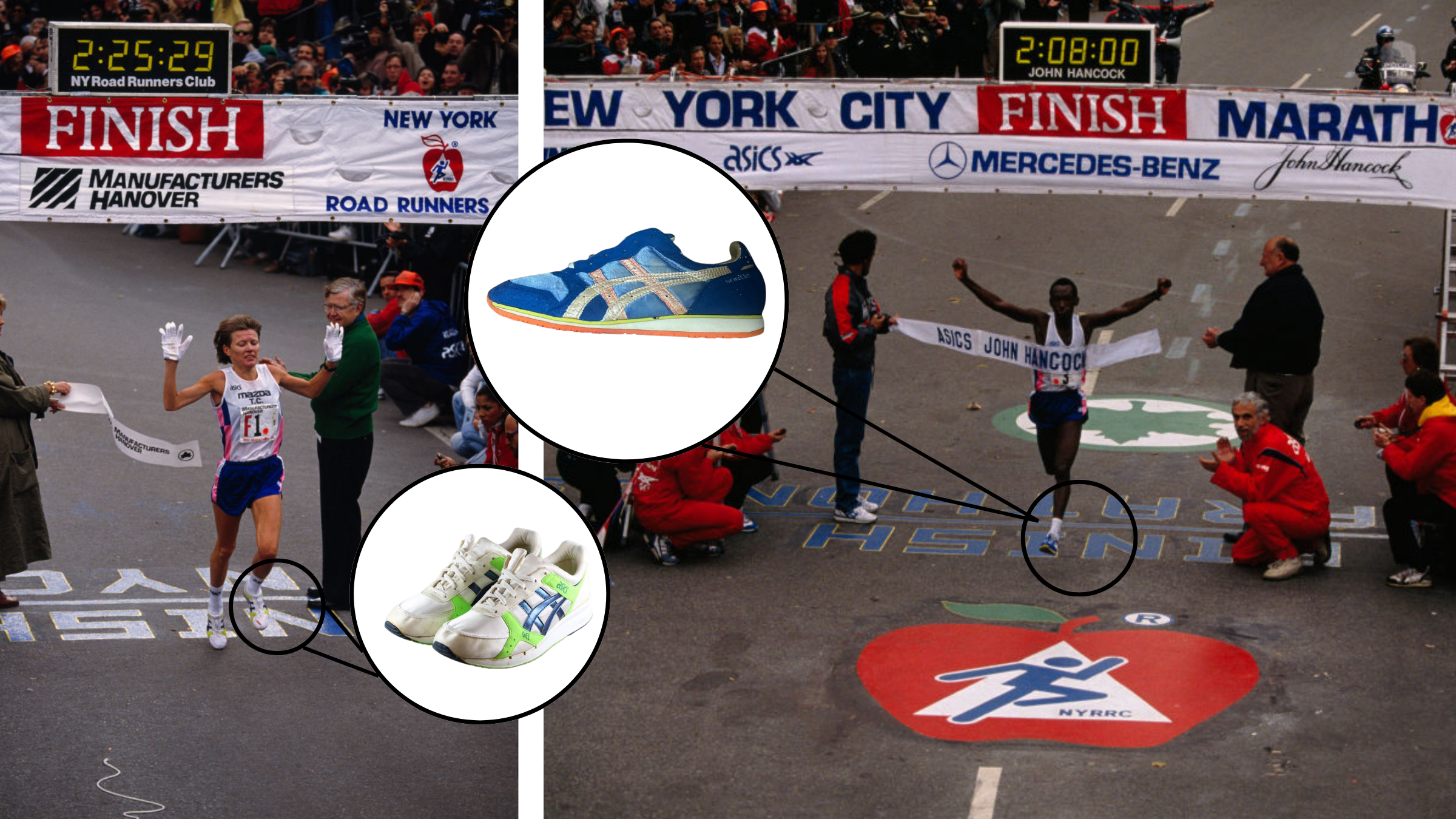
Former world record holder Steve Jones won in 1988 and hounded Ikangaa that next year, his shoes, the simple yet effective Reebok World Best. Also during the 1989 race, reigning world record holder Ingrid Kristiansen missed out on the course record by one second. She wore the Asics Gel-LD Racer.
ADVERTISEMENT
Nike Rules the Nineties
Men’s Fastest Times of the Decade
| Time | Year | Athlete | Shoe |
| 2:08:12 | 1997 | John Kagwe | Nike Air Streak Vengeance |
| 2:08:45 | 1998 | John Kagwe | Nike Air Streak Vengeance |
| 2:08:48 | 1998 | Joseph Chebet | Fila Racer |
Women’s Fastest Times of the Decade
| Time | Year | Athlete | Shoe |
| 2:24:40 | 1992 | Lisa Ondieki | Nike Mariah |
| 2:25:06 | 1999 | Adriana Fernandez | Nike Air Zoom Streak |
| 2:25:17 | 1998 | Franca Fiacconi | Adidas Converter |
In the 90s the field grew to 32,503 starters for the 1999 New York City Marathon. Lisa Ondieki set the 90s standard with her dominant win in 1992, her course record the fastest time of the decade. She wore the Nike Mariah PR, the successor to the hugely significant Nike Mariah of 1980. Both used full-length air cushioning to improve the performance of elite runners. The original Mariah promised running efficiency gains of 2%, similar to another famous Nike… (Yes, I’m speaking of the Vaporfly 4% in case you’ve been living in a supershoe cave.)
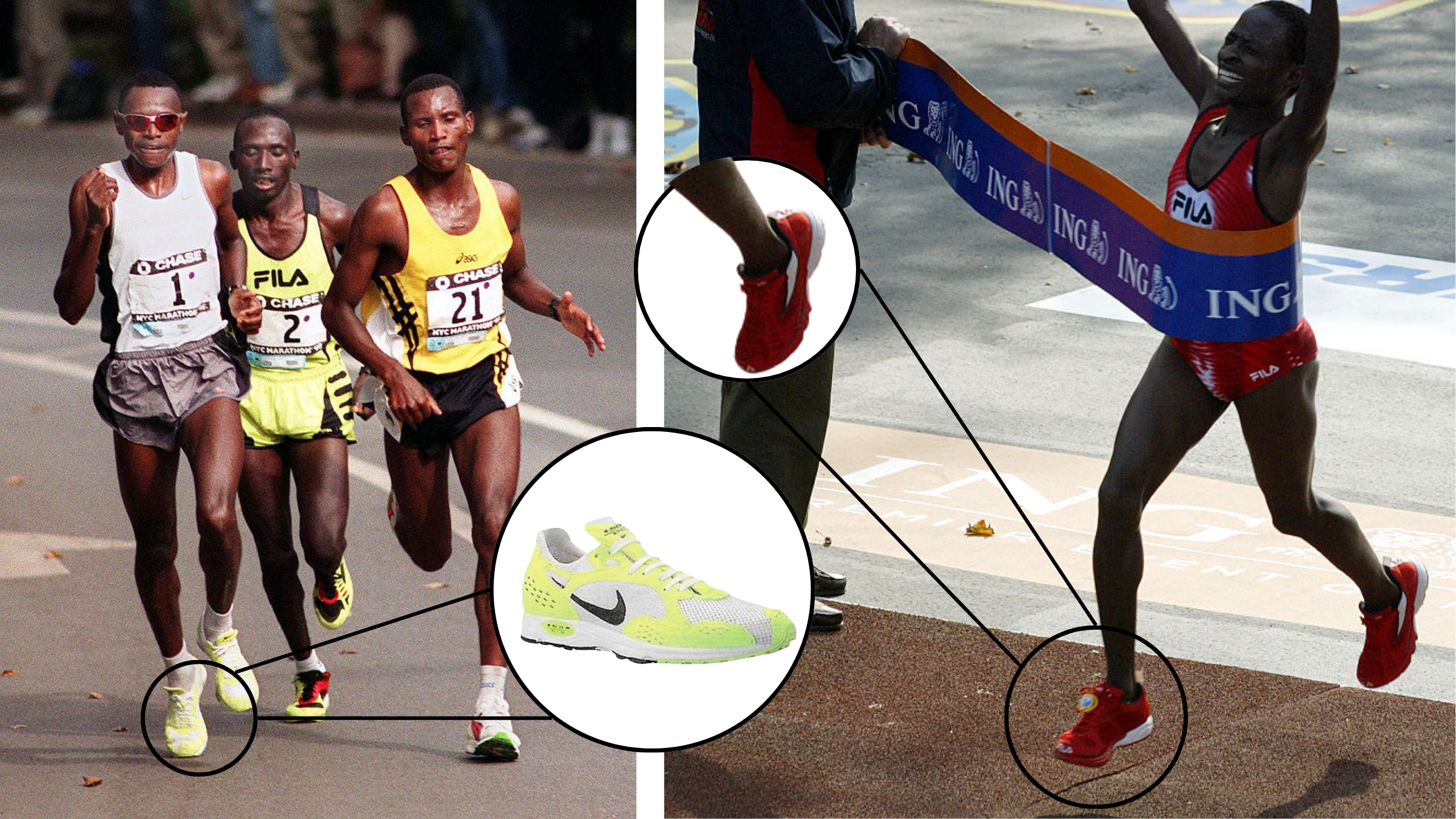
The technology evolved into Zoom Air, found in the Nike Air Zoom Streak, which powered Adriana Fernández to her victory in 1999, and in the Air Streak Vengeance that John Kagwe wore to win in 1997 and 1998. In some of the great marathon shoe lore, Kagwe wore a brand new pair of shoes and battled loose laces on his way to win in 1997.
Franca Fiacconi set the third fastest time of the decade in the distinctive yet technologically simple Adidas Converter. It was Joseph Chebet who wore the most significant shoes that decade on his way to the third fastest men’s time: the Fila Racer, sequel to the 1997 Silva Racer that was the first ever road racer to have a carbon-fiber plate in the sole (although it was flat and worked differently than the curved ones in today’s super shoes).
ADVERTISEMENT
Zoom Through the Aughts
Men’s Fastest Times of the Decade
| Time | Year | Athlete | Shoe |
| 2:07:43 | 2001 | Tesfaye Jifar | Nike Air Streak Vengeance |
| 2:08:07 | 2002 | Rodgers Rop | Nike Air Streak |
| 2:08:17 | 2002 | Christopher Cheboiboch | Saucony Static Racer |
Women’s Fastest Times of the Decade
| Time | Year | Athlete | Shoe |
| 2:22:31 | 2003 | Margaret Okayo | Fila Racer |
| 2:23:03 | 2003 | Catherine Ndereba | Nike Air Streak Ekiden IV |
| 2:23:09 | 2007 | Paula Radcliffe | Nike Air Zoom Marathoner |
At the end of the decade, the 2009 New York City Marathon had an incredible 43,659 runners reach the finish. The event also joined the inaugural World Marathon Majors in 2006.
Margaret Okayo set a new course record with her 2003 win, wearing the Fila Racer. Right behind her, and second fastest that decade, was former world record holder Catherine Ndereba in the Nike Air Streak Ekiden IV that used Zoom Air cushioning under the heel. It was part of an extensive range of Nike Air Streak racing shoes launched in 1995, offering many different combinations of Zoom Air units, with some models weighing as little as 150 grams. The incomparable Paula Radcliffe was third fastest during the decade with her win at the 2007 race. She wore the Air Zoom Marathoner designed to her exacting specifications.
ADVERTISEMENT
Tesfaye Jifar won with a course record in 2001, breaking the 2:08 barrier, his preference the Air Streak Vengeance with Zoom Air front and back. Unlike Kagwe’s, they were properly worn in.
Rodgers Rop took victory in 2002 in the updated Air Streak, with heel Zoom Air, outsprinting Christopher Cheboiboch in what appears to be the Saucony Static Racer.
Foam Parties of the 2010s
Men’s Fastest Times of the Decade
| Time | Year | Athlete | Shoe |
| 2:05:06 | 2011 | Geoffrey Mutai | Adidas Adizero Feather |
| 2:05:59 | 2018 | Lelisa Desisa | Nike Zoom Vaporfly 4% Flyknit |
| 2:06:01 | 2018 | Shura Kitata | Nike Zoom Vaporfly 4% Flyknit |
Women’s Fastest Times of the Decade
| Time | Year | Athlete | Shoe |
| 2:22:38 | 2019 | Joyciline Jepkosgei | Adidas Adizero Takumi Sen 5 |
| 2:22:48 | 2018 | Mary Keitany | Adidas Adizero Takumi Sen 3 |
| 2:23:15 | 2011 | Firehiwot Dado | Nike Zoom Streak 3 |
By the end of the 2010s, over one million runners had finished the New York City Marathon, with 53,640 finishers in 2019. The 2018 arrival of the Nike Zoom Vaporfly 4% launched the modern era of supershoes. Lelisa Desisa and Shura Kitata set the second and third best NYCM times of the decade wearing them. What differentiated them from earlier plated shoes was supercritical (gas-infused) Polyether Block Amide, or PEBA, an ultra-light, hyper-bouncy foam that revolutionised what could be done with stack heights and curved, rigid plates.
ADVERTISEMENT
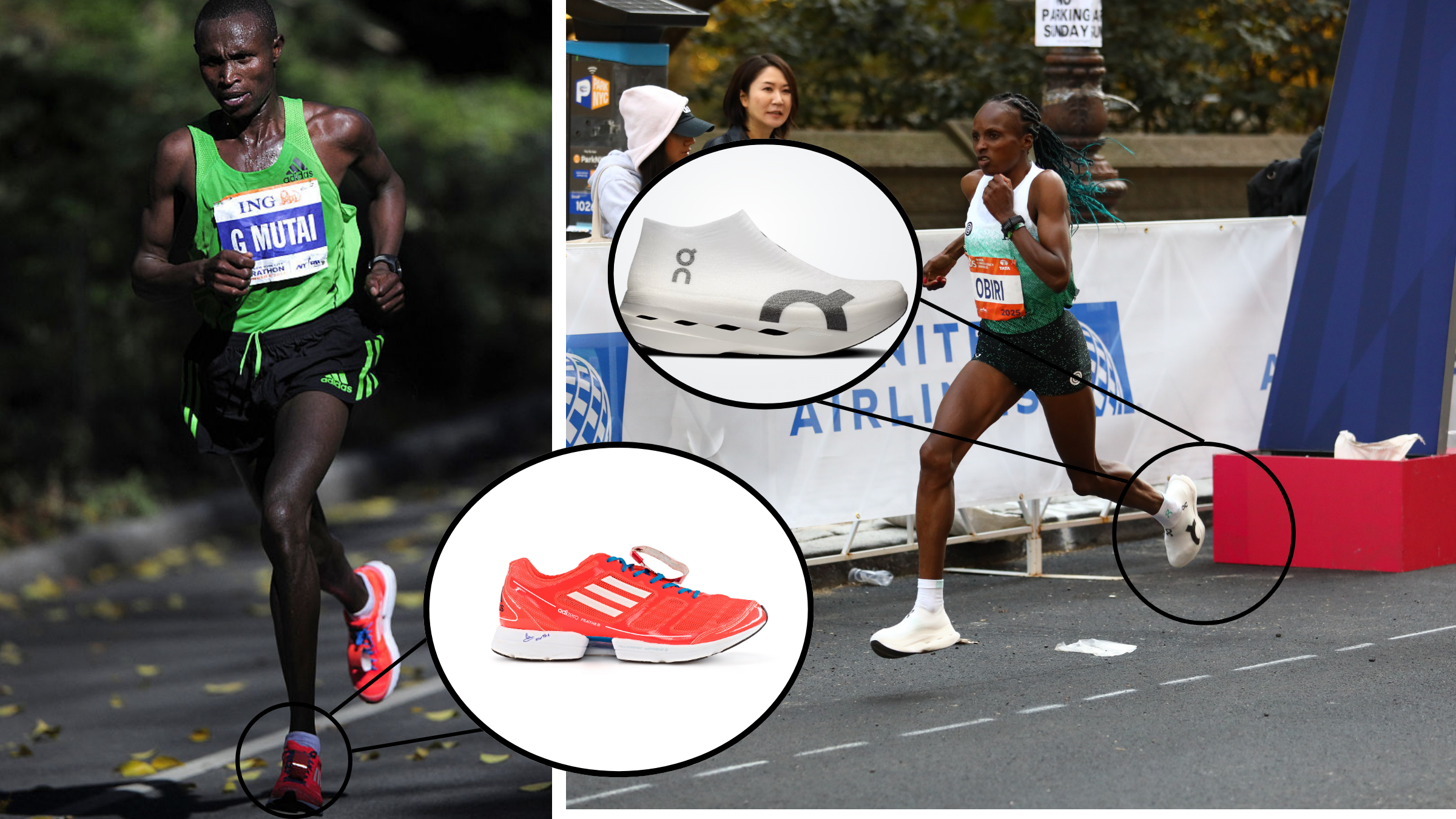
Nonetheless, it was Geoffrey Mutai who set the fastest time of the decade in 2011 wearing the far less revolutionary Adidas AdiZero Feather, its claim to fame the use of an arch bridge to allow part of the EVA foam midsole to be removed to reduce weight. Mutai was met with perfect conditions and ran the new course record. Adidas similarly claimed bragging rights to the fastest women’s times, with Joyciline Jepkosgei and Mary Keitany winning in 2019 and 2018, respectively.
Jepkosgei wore the Adizero Takumi Sen 5, Keitany the Takumi Sen 3, both featuring forefoot slivers of the high-rebound Thermoplastic Polyurethane foam or TPU known as Boost. The models were the latest in the Adizero line Adidas launched in 2004. Third fastest was Firehiwot Dado in 2011 in the 2009 Nike Zoom Streak 3, its combination of Zoom Air and lightweight construction making it the preference of elite athletes as late as 2015 despite being superseded by thick-soled super shoes.
The Modern Era of Fastest Shoes
Men’s Fastest Times of the Decade (So Far)
| Time | Year | Athlete | Shoe |
| 2:04:58 | 2023 | Tamirat Tola | Adidas AdiZero Adios Pro Evo 1 |
| 2:06:57 | 2023 | Albert Korir | Adidas Adizero Adios Pro 3 |
| 2:07:11 | 2023 | Shura Kitata | Nike ZoomX VaporFly Next %2 |
Women’s Fastest Times of the Decade (So Far)
| Time | Year | Athlete | Shoe |
| 2:19:51 | 2025 | Hellen Obiri | On CloudBoom Strike LS |
| 2:20:07 | 2025 | Sharon Lokedi | Under Armour Velociti Elite 3 |
| 2:20:24 | Sheila Chepkirui | Adidas Adizero Adios Pro 4 |
Last year, on the women’s side, Hellen Obiri broke the 2:20 barrier on the notoriously difficult course in the PEBA-equipped On CloudBoom Strike LS. Its innovative, 30-gram, laceless Lightspray upper is created by robots weaving one continuous thread. (Obiri returns this year — we’ll see which On’s she dons on Nov. 1.)
Sharon Lokedi brought attention to Under Armour by coming in second behind Obiri in the Velociti Elite 3, their version of a super shoe racer with a carbon-fiber plate embedded in a responsive HTPU midsole. Sheila Chepkirui rounded out the fastest women’s times so far this decade in the Adidas Adizero Adios Pro 4, a speedy shoe found on many of the fastest runners’ feet, which notably deviated from the plate formula by using specially shaped rods that mimic the bones in the human foot, embedded in the high-energy TPEE superfoam.
ADVERTISEMENT
Tamirat Tola used this technology to devastating effect by breaking the 2:05 barrier at the 2023 race in the Adizero Adios Pro Evo 1, the lightest super shoe at the time, weighing less than 5 ounces. Albert Korir used the Adizero Adios Pro 3 to go second fastest in the 2023 race and this decade. Kitata rounded out the podium in the 2021 Nike ZoomX Vaporfly Next%, proving that despite Adidas’ dominance, Nike is still in the mix.